Types of Industrial Stainless Steel Storage Tanks and How to Choose One
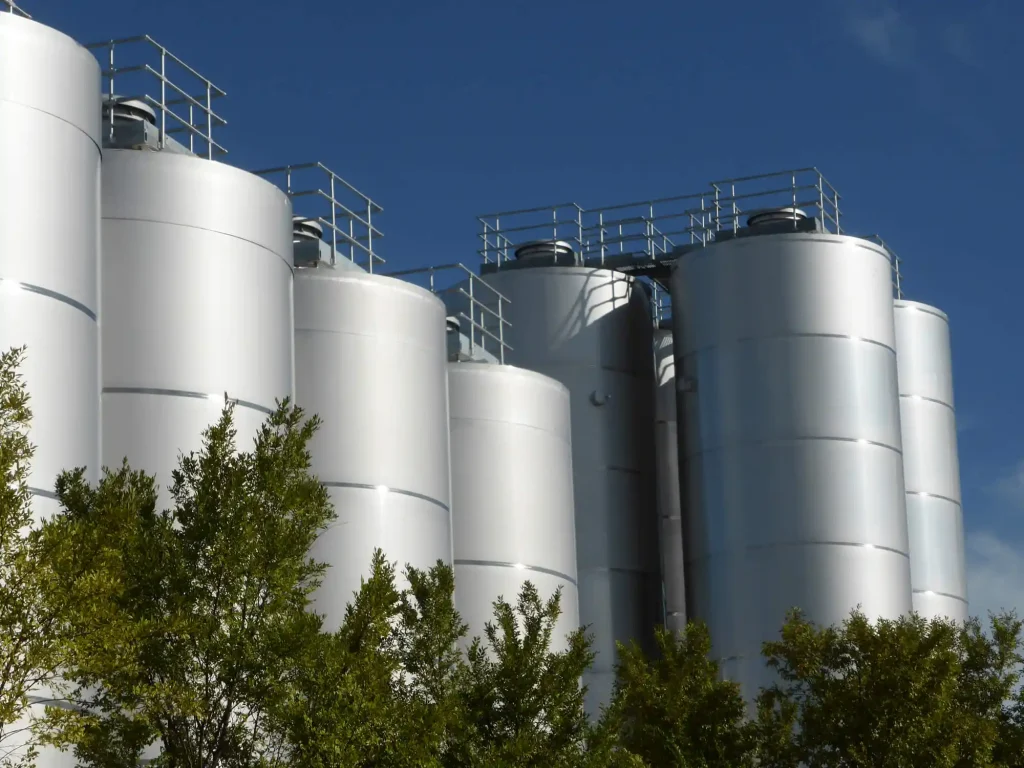
Choosing the wrong storage vessel shows up fast on a factory floor. Dead corners trap residue during cleaning, thin shells lose cooling in summer heat, and the wrong alloy starts pitting along weld seams inside a single year. Understanding the main designs of stainless steel storage tanks lets your engineering team match shell shape, bottom angle, and steel grade to your liquid before fabrication begins.
Industrial storage tanks serve food, dairy, beverage, edible oil, chemical, and pharmaceutical plants. Each sector handles liquids with different viscosity, acidity, temperature limits, and hygiene audit rules. A vertical indoor tank built for refined vegetable oil fails quickly if you move it outdoors to hold chilled raw milk or acidic brine.
Storage Tanks Compared With Process Tanks
Before comparing tank designs, separate static holding from active processing. A storage tank holds raw materials, intermediate batches, or finished liquids at atmospheric pressure with basic level gauges and clean drainage. The liquid stays still or moves only under gentle agitation to prevent separation.
Active production lines need stainless steel process tanks instead. Process vessels change the liquid through rapid heating, cooling, high-shear blending, or fermentation. Because agitator torque and thermal cycling stress the metal, process vessels require thicker shells, reinforced top heads, and heavy motor mounts. Buying a process vessel for simple holding wastes capital, while pushing a light storage shell into high-shear blending risks structural fatigue.
Main Types of Industrial Stainless Steel Storage Tanks by Design
Factory layout, liquid behavior, and delivery access narrow your choices down to nine practical tank architectures.
Vertical Storage Tanks
Vertical cylindrical vessels are the standard layout for indoor plant rooms. They stack capacity upward, which leaves more floor space open for piping, pumps, and walkways. Most vertical units stand on stainless pipe legs with adjustable footplates or sit directly on a concrete plinth via a welded skirt. Gravity works in your favor here, because a tall liquid column improves pump suction head and speeds up complete discharge.
Horizontal Storage Tanks
Some processing rooms have low ceiling beams, overhead cranes, or narrow mezzanine clearances that block upright vessels. Horizontal tanks solve that clearance limit by laying the cylinder along two or more reinforced stainless saddle supports. Cleaning takes closer planning on a horizontal shell. Because the internal wall spans a wider length, a single central spray ball leaves dry shadows at both ends, so horizontal sanitary tanks usually need two or three spaced cleaning nozzles.
Outdoor Silo Tanks
High-volume factories often run out of indoor space first. Outdoor silo tanks move bulk holding outside the building wall while keeping the alcove, valves, and sampling ports tucked cleanly inside the plant room. Say a dairy plant receives 40,000 L of raw milk every shift. Putting that volume in an outdoor insulated silo saves roughly 15 square meters of expensive conditioned floor area inside the processing hall.
Jacketed and Insulated Storage Tanks
Bare stainless steel conducts heat rapidly. During 50 C summer afternoons across GCC industrial zones, direct sunlight pushes an uninsulated tank wall past 65 C. Chilled milk, juice concentrates, or temperature-sensitive chemicals warm up quickly and force plant chillers to run nonstop.
Insulated storage tanks stop that heat gain by wrapping the inner shell in 75 mm to 100 mm of polyurethane foam or mineral wool beneath a fully welded stainless steel outer cladding. When a stored liquid also needs active warming or cooling, fabricators weld dimple jackets or half-pipe coils directly onto the inner shell to circulate steam, hot water, chilled water, or glycol.
Double-Wall Containment Storage Tanks
Aggressive acids, solvents, and hot oils create safety and environmental hazards if a weld or fitting leaks. Double-wall storage tanks place a complete secondary stainless shell around the primary vessel with a monitored gap between the two walls. If the inner tank ever develops a leak, the outer containment shell traps the liquid before it reaches factory drains or concrete floors.
Pressurized and Vacuum Storage Vessels
Standard atmospheric tanks operate at 0 bar gauge pressure and rely on breather vents to keep internal pressure balanced during filling and emptying. If a production line uses nitrogen blanketing, sterile positive air pressure, steam sterilization, or vacuum transfer, an atmospheric shell will buckle or rupture. Those duties require engineered stainless steel pressure vessels built with thicker walls, torispherical heads, and certified pressure relief valves.
API 650 Flat-Bottom and Site-Built Tanks
Highway width puts a hard limit on factory-built vessel diameter, typically around 4.0 m to 4.5 m depending on local transport corridors. Bulk edible oil refineries and chemical terminals often need much wider capacities. API 650 flat-bottom storage tanks handle those massive footprints on prepared ring-wall foundations. When dimensions exceed road permits, site built stainless steel tanks are pre-cut and rolled at the workshop, shipped flat in sections, and welded and tested directly inside your facility.
Bolted Stainless Steel Storage Tanks
Remote plant locations and tight container budgets make large welded shipments expensive. Bolted stainless steel tanks use pre-punched modular panels that pack flat into standard shipping containers and bolt together on site with industrial sealants and gaskets. Assembly moves quickly with smaller lifting gear. The trade-off is hygiene. Because internal bolted seams and gasket lines can trap residue, bolted tanks fit industrial bulk holding well, while welded shells remain the standard for strict dairy, aseptic, and pharmaceutical lines.
Buffer, CIP, Mobile, and Multi-Chamber Tanks
Several specialized storage designs solve specific line bottlenecks:
- Buffer and Aseptic Buffer Tanks. Standard buffer vessels absorb flow swings between continuous upstream equipment and high-speed downstream fillers. Aseptic buffer tanks add sterile positive air pressure between a UHT sterilizer and the filler so ambient air cannot recontaminate sterile liquids.
- CIP Tanks. Clean-in-place (CIP) systems wash internal piping and vessels without taking equipment apart. Dedicated stainless CIP tanks hold caustic soda, acid detergent, and rinse water ready for automated wash cycles.
- Mobile Storage Tanks. Compact sanitary vessels mounted on heavy-duty lockable casters handle pilot batches, flavor staging, and flexible transfers across rooms.
- Multi-Chamber Tanks. One upright shell divided by internal bulkheads stores two or three separate liquids within a single floor footprint without cross-contamination.
Quick Comparison of Industrial Stainless Steel Storage Tank Types
| Tank Design | Typical Placement | Best Suited Duty | Primary Constraint |
| Vertical Storage Tank | Indoor plant floor | General liquid holding and daily batches | Needs adequate overhead ceiling height |
| Horizontal Storage Tank | Low-ceiling rooms or mezzanines | Tight vertical clearance and crane bays | Larger floor footprint and multiple spray balls |
| Outdoor Silo Tank | Exterior concrete pad | High-volume dairy, oil, and beverage storage | Needs heavy thermal insulation in hot climates |
| Jacketed and Insulated Tank | Indoor or outdoor | Temperature-controlled holding and cooling | Higher fabrication cost than bare single wall |
| Double-Wall Tank | Chemical and oil storage zones | Secondary leak containment for hazardous fluids | Added weight and leak-sensor monitoring |
| Pressure or Vacuum Vessel | Pressurized process lines | Nitrogen blanketing, steam, or vacuum duty | Requires code design and certified relief valves |
| API 650 / Site-Built Tank | Bulk terminals and refineries | Oversized volumes above road width limits | Requires on-site welding crews and foundation work |
| Bolted Stainless Tank | Remote sites and tight access | Low-freight modular bulk storage | Internal gasket seams limit strict sterile use |
| Buffer, CIP, and Mobile Tanks | Inside active production lines | Surge control, plant washing, pilot transfers | Sized strictly to line flow rate and wash cycles |
Tank Bottom Shapes and Drainage Performance
Shell geometry controls where the tank fits, while bottom geometry decides how cleanly your product empties.
- Sloped Flat Bottoms. Built with a slight 2-degree to 5-degree tilt toward a side or offset outlet. They work reliably for thin, free-flowing liquids such as fresh milk, refined edible oil, and clear juices while keeping overall tank height low.
- Torispherical (Dished) Bottoms. Curved knuckle transitions distribute internal weight and pressure evenly across the base. Dished bottoms drain well during automated CIP cycles and handle both atmospheric and pressurized duties.
- Conical Bottoms. Built at angles between 15 degrees and 60 degrees. Viscous sauces, concentrated syrups, cream, and slurries carrying heavy sediment cling to shallow floors. A steep 60-degree cone channels thick product straight into the discharge pump with minimal waste left behind.
How to Choose the Right Stainless Steel Storage Tank
Walk through five engineering checks in order so you do not overpay for unused features or under-spec a critical wall.
1. Match Steel Grade to Liquid Chemistry
Alloy choice decides how many years a vessel runs before corrosion forces a shutdown. Neutral liquids such as fresh milk, refined vegetable oil, and sugar syrups at moderate temperatures run safely in AISI 304 stainless steel at a lower upfront cost.
Suppose a factory stores citrus concentrate or 3% brine solution at 60 C inside an AISI 304 shell. Chloride ions attack the weld seams and open microscopic pits within months. Switching to AISI 316L adds 2% to 3% molybdenum to the steel, which stops pitting corrosion under acids, chlorides, and hot caustic CIP washes. Plant engineers ordering food grade stainless steel tanks often run AISI 304 for neutral ingredients and upgrade to AISI 316L for acidic sauces and brines, while chemical stainless steel tanks rely heavily on thick-wall AISI 316L.
2. Size Working Volume With Proper Headspace
Never order a tank whose total geometric volume equals your exact batch size. Liquids expand during heating, wave during agitation, and foam during pumping. Add 10% to 15% headspace above working volume for calm liquids, and up to 25% for foaming dairy mixes or aerated syrups. For example, a 10,000 L foaming dairy batch calls for a total geometric vessel volume between 12,000 L and 12,500 L.
3. Specify Internal Surface Finish and Weld Passivation
Surface smoothness inside a sanitary tank is measured as Ra in micrometers. Lower Ra values mean smoother metal with fewer microscopic grooves where bacteria can attach. Food, dairy, beverage, and edible oil tanks typically require a mechanical internal polish of Ra 0.8 µm or finer so fats and proteins rinse clean during wash cycles. Sterile aseptic vessels and pharmaceutical tanks usually call for electropolished Ra 0.4 µm interiors.
Internal weld quality matters just as much as plate polish. Every sanitary seam needs flush TIG grinding followed by chemical passivation, an acid treatment that removes free iron and restores the protective chromium oxide layer along the weld.
4. Account for Pressure, Temperature, and Ambient Heat
Check your maximum operating temperature, highest CIP wash temperature, and whether the shell will see vacuum during rapid cold rinsing. Hot CIP wash water followed by a cold rinse creates sudden vapor condensation inside a closed tank. Without a properly sized vacuum breaker or pressure-rated shell, that sudden pressure drop can collapse an atmospheric tank in seconds. For outdoor tanks in hot climates, specify full insulation cladding from the start.
5. Plan Clearances, Fittings, and Quality Documentation
Measure factory doors, truck turning radii, ceiling beams, and existing pipe racks before approving drawings. Standard catalog dimensions often clash with older plant rooms, which is where custom stainless steel tanks save costly building modifications.
Order radar level transmitters, load-cell brackets, PT100 temperature probes, manways, and CIP spray manifolds mounted at the factory before shipping. Cutting and welding nozzles on site damages internal polish and risks weld contamination. Finally, ask your fabricator for EN 10204 3.1 steel mill certificates (which trace every plate back to its foundry melt batch), hydrostatic water leak test records, and Ra surface roughness logs before dispatch.
Engineering Your Next Storage Tank With DTECH
DTECH manufactures industrial stainless steel tanks and stainless steel storage tanks in-house for food, dairy, beverage, edible oil, chemical, and pharmaceutical factories across the GCC and export markets.
To size wall thickness, verify steel grade compatibility, and prepare a layout drawing with a technical quote, send our engineering desk six process details:
- Stored liquid type, pH value, chloride content, and viscosity in cP
- Required working capacity in L and total number of tanks
- Operating temperature range and CIP wash temperature in C
- Atmospheric, vacuum, or positive pressure requirements
- Indoor or outdoor placement plus door and ceiling clearances
- Required fittings such as insulation, agitators, load cells, or level sensors
Frequently Asked Questions
What is the difference between a stainless steel storage tank and a process tank?
A storage tank holds liquid statically at ambient or chilled temperatures with basic drainage and level monitoring. A process tank changes the product actively through heating, cooling, high-shear mixing, or fermentation, which calls for thicker shells, thermal jackets, and heavier agitator mounts.
When should a factory pick a horizontal storage tank instead of a vertical tank?
Choose a horizontal layout when low ceilings, overhead cranes, or mezzanine beams prevent upright installation. Vertical shells take less floor space and drain more easily by gravity, so horizontal tanks make sense mainly when headroom is restricted.
How much headspace do you need above the working liquid volume?
Plan for 10% to 15% extra geometric volume above your batch size for calm liquids, and up to 25% if the liquid foams during filling or agitation. That margin stops overflow during thermal expansion and keeps CIP spray balls clear of the liquid surface.
Which tank bottom shape drains thick sauces or heavy liquids cleanest?
A 60-degree conical bottom gives the fastest, cleanest discharge for viscous sauces, syrups, and slurries containing sediment. Sloped flat bottoms work well for thin fluids like fresh milk or refined oil, while thick products cling to shallow angles and raise product loss.
When does an industrial liquid require AISI 316L instead of AISI 304?
Specify AISI 316L whenever the stored fluid contains salt, brine, organic acids, sulfur compounds, or aggressive caustic wash chemicals above 50 C. AISI 304 works reliably with neutral products at moderate temperatures, while chlorides trigger pitting corrosion along 304 welds.
What does Ra surface roughness mean for sanitary storage tanks?
Ra measures the microscopic height of peaks and valleys on the inside metal wall in micrometers. Standard food, dairy, and edible oil vessels typically use Ra 0.8 µm mechanical polish for clean washdowns, while sterile aseptic and pharmaceutical vessels require Ra 0.4 µm electropolished finishes.
How thick should thermal insulation be for an outdoor tank in hot climates?
Outdoor chilled or temperature-sensitive vessels in 50 C summer heat typically use 75 mm to 100 mm of polyurethane foam or mineral wool sealed under welded stainless steel cladding. That thermal barrier blocks direct solar radiation and reduces continuous load on factory chillers.
How are storage tanks wider than highway limits delivered to a factory?
When a vessel exceeds road transport width (typically 4.0 m to 4.5 m), fabricators pre-cut and roll the steel plates and structural rings at the shop, ship them flat, and complete final welding inside your facility. After assembly, the tank passes weld inspection, passivation, and hydrostatic water testing before commissioning.
What happens if internal tank welds skip flush grinding and passivation?
Rough weld beads and heat-tint oxide layers trap organic residue that spray balls cannot wash out. Within a few shifts, bacteria multiply along those unpolished seams, shorten shelf life, and cause failures during hygiene audits.
When do bolted stainless steel storage tanks work better than welded tanks?
Pick bolted vessels when container freight costs are high, plant access roads are narrow, or fast modular erection is needed at a remote site. Welded shells stay the safer standard for strict dairy, aseptic, and pharmaceutical lines because flush welds remove internal gasket joints.
Can you use an atmospheric storage tank under vacuum or steam pressure?
Atmospheric shells are engineered only for ambient pressure and will buckle under vacuum or rupture under steam pressure. Even a cold rinse right after hot CIP washing can collapse an atmospheric tank unless a properly sized vacuum breaker or a pressure-rated vessel is installed.
Which inspection certificates should ship with an industrial stainless steel storage tank?
Every standard industrial delivery should include EN 10204 3.1 steel mill certificates linking each plate to its foundry batch, hydrostatic leak test sheets, and internal Ra roughness readings. Ultrasonic, dye-penetrant, or radiographic weld reports can be added for pressurized or high-risk chemical vessels.