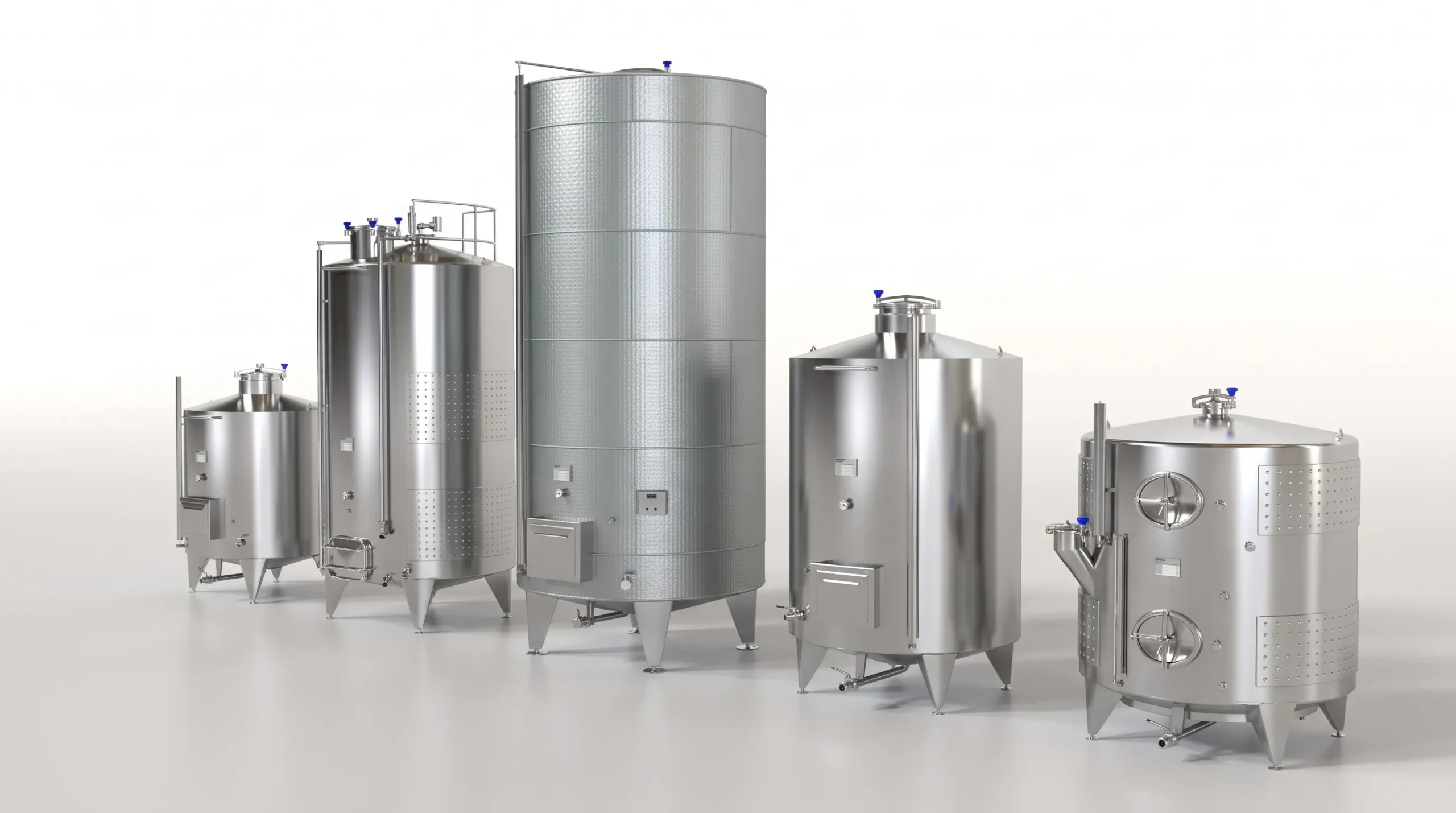
DTECH fabricates industrial stainless steel storage and process tanks in-house. Every shell uses certified AISI 304 or AISI 316L steel.
Send our engineers your liquid properties, operating temperatures, and floor limits. We size the wall thickness, dimple jacket, agitator, and clean-in-place (CIP) spray hardware around your line, then pressure-test every finished vessel before dispatch.
Our tanks operate in food, dairy, beverage, edible oil, chemical, and pharmaceutical factories across the GCC and export markets.
Complete liquid drainage
Atmospheric bulk storage vessels built with sloped or conical bottoms for complete liquid drainage.
Storage TanksActive in-line production
Active production vessels built for heating, cooling, blending, and batch standardization inside your line.
Process TanksHigh-load plant duties
Pressurized and vacuum-rated stainless steel shells engineered and tested for high-load plant duties.
Pressure VesselsBuilt around tight plant rooms
Custom vessel dimensions, nozzle layouts, load-cell mounts, and agitator angles built around tight plant rooms.
Custom TanksWelded and hydro-tested on site
Oversized tanks pre-rolled in our shop, shipped flat as plates, and welded and hydro-tested directly at your site.
Site Built TanksHygienic Ra 0.8 µm finish
Hygienic food vessels built with flush ground welds, food-contact gaskets, and smooth Ra 0.8 µm internal finishes.
Food Grade TanksHeavy-wall AISI 316L resistance
Heavy-wall AISI 316L chemical storage, mixing, and dosing vessels built to resist acids, chlorides, and harsh washes.
Chemical TanksCustom Engineering Consultation
Not every factory fits standard catalog diameters. Message our engineers on WhatsApp to review your process and receive a layout drawing and non-binding quotation.
Stainless steel is the right material for liquids that have to stay clean. It lasts for years, sanitizes easily, and resists corrosion. But a tank is only as good as its steel grade, its welds, and its fittings, and those are choices best made with the people who build it.
Whether it’s a mixing tank, a bulk storage vessel, or a custom build with specialized fittings, the design is yours to specify. Our engineers size it around your product and your floor space, and add a dimple jacket, agitator, insulation, or CIP spray hardware where the process needs one. Everything is cut, rolled, welded, and tested in-house, so there is no middleman between your drawing and the finished vessel.
Example: a factory stores citrus concentrate or 3% brine at 60 °C in a standard AISI 304 shell. Chloride ions attack the weld seams and open microscopic pits within months. We flag that risk during sizing and switch the build to AISI 316L, whose 2% to 3% molybdenum stops pitting under hot acidic liquids and caustic wash cycles.
Pick the vessel that matches your product, your floor space, and your process.
Top-entry, side-entry, or bottom-entry agitator vessels matched to viscous sauces, dairy mixes, and chemical slurries.
Dimple-jacketed and half-pipe coil shells built for controlled heating and cooling with steam, chilled water, or glycol.
Tall outdoor vertical silos from 50,000 L upward that keep indoor floor space free for processing machinery.
Modular bolted stainless vessels that ship flat in standard containers and assemble quickly on remote sites.
Complete multi-tank storage zones combining bulk vessels, transfer pumps, walkways, hygienic manifolds, and automated valves.
Process surge vessels that absorb flow swings between continuous upstream machines and high-speed fillers.
Sterile positive-pressure vessels installed between UHT sterilizers and fillers to block airborne recontamination.
Secondary containment shells built around corrosive chemicals or oils to catch leaks before they reach the floor.
60-degree cone-bottom vessels built for clean yeast, culture, and sediment discharge.
Dedicated caustic, acid, and rinse holding vessels wired directly into automated plant cleaning cycles.
Slow-cooling vessels with wall-scraping agitators built for edible oil winterization and fractionation.
Upright shells divided into separate compartments so one footprint stores two or three liquids without mixing.
Reinforced chemical reaction vessels fitted with mechanical shaft seals, baffles, and temperature control jackets.
Large flat-bottom welded storage vessels engineered for bulk industrial terminals.
Upright shells for tight floor footprints or horizontal shells for low-ceiling rooms.
Insulated reception silos, cream aging vessels, and milk coolers built for hot climates.
Sugar dissolvers, juice blending vessels, and crude or refined oil storage tanks.
Electropolished vessels built to Ra 0.4 µm internal finishes for strict batch validation.
Dedicated alloy and outdoor thermal builds for regional operating conditions.
Tell our engineers what you store, at what temperature, and how much floor space you have. They will size a tank around your line.
Request a quoteCleaning rules and chemical loads change sharply across processing sectors. We configure gaskets, surface finishes, and wall thicknesses to match the audits your plant faces.

Sanitary food grade stainless steel tanks with flush internal seams for sauces, syrups, seasonings, and liquid foods.
Insulated reception silos, cream aging vessels, and balance tanks built to integrate with a complete dairy processing plant.
Syrup dissolving tanks, blending vessels, and deaeration buffers built for any beverage production line or fruit juice processing line.
Neutralizers, bleaching vessels, winterization crystallizers, and finished oil storage tanks for an edible oil refinery plant.
Heavy-wall chemical stainless steel tanks for wet chemical mixing, dosing, and acid storage alongside our chemical process equipment.
Electropolished vessels with Ra 0.4 µm interiors and crevice-free ports for strict batch validation.
Share these six process details with our engineering desk so we can calculate shell thickness, confirm alloy compatibility, and prepare your drawing and price.
Request a quoteStorage vessels hold liquid at ambient or chilled temperatures with drainage and level monitoring. Process vessels perform active work such as heating, cooling, high-shear blending or fermentation. Their shell thickness, thermal jackets and agitator supports are designed around those operating loads.
Consider AISI 316L when the product or cleaning cycle creates a greater corrosion risk. Provide the chemical composition, chloride concentration, pH and maximum temperature for material selection. AISI 304 can suit compatible duties such as fresh milk and refined vegetable oil. AISI 316L offers improved resistance in some environments, but aggressive chlorides or acids may require a different alloy.
Hygienic food and beverage projects commonly specify an internal finish of Ra 0.8 µm or finer. Aseptic and pharmaceutical projects may specify Ra 0.4 µm and electropolishing. The required finish, weld treatment and measurement method should follow the product, cleaning process and agreed validation requirements.
Transport limits depend on the route, permits and local regulations. When a completed vessel exceeds the available clearances, plates and structural rings can be prepared in the workshop and delivered in sections. The shell is assembled at the plant, followed by the agreed weld inspection, surface treatment and hydrostatic or leak testing before commissioning.
Insulation beneath stainless steel cladding reduces heat transfer from the surroundings. Polyurethane foam or mineral wool thickness is selected using the ambient conditions, product temperature, holding time and permitted temperature rise. A 75 mm to 100 mm layer may suit some projects. Chilled storage may also need active cooling to maintain its target temperature.
Agree the inspection dossier when ordering. It can include EN 10204 3.1 material certificates, plate traceability records, hydrostatic or leak test reports and internal surface roughness readings. Ultrasonic, dye-penetrant or radiographic weld reports can be specified where required by the project.
A preliminary allowance may be 10% to 15% above working volume for calm liquids and 20% to 25% for foaming batches. A 10,000 L working batch would therefore correspond to a total volume of 12,000 L to 12,500 L at the higher allowance. Confirm the final headspace against agitation, foaming, filling rate and operating level requirements.
Rough weld profiles, defects and residual heat tint can reduce cleanability or corrosion resistance. Specify an acceptable weld profile, surface finish and post-weld treatment for the hygienic duty. Flush grinding is applied where the specification requires it, while suitably executed as-welded seams may be acceptable in other designs.
Bolted assemblies can simplify container freight and installation at remote sites with restricted access. Check gasket compatibility, internal joints and cleaning requirements against the intended liquid. Welded vessels are commonly selected for demanding hygienic and aseptic duties where a continuous product-contact surface is required.
Yes. Radar level transmitters, thermowells, weigh-module brackets and CIP hardware can be included in the fabrication scope. Define their locations and interfaces on the approved drawings to reduce site modifications. Final installation and calibration may be completed at the plant depending on transport and commissioning requirements.