Skim Milk Powder (SMP)
Classified by Whey Protein Nitrogen Index (WPNI), measuring undenatured whey protein (mg/g). Spray drying achieves superior agglomeration for instant milk powder, while drum drying suits chocolate caramelization.

DTECH · Spray Drying & Evaporation
Engineered to convert liquid feeds into uniform, high-purity powders—even for heat-sensitive dairy, food, and chemical materials—with integrated falling-film evaporation and fines re-circulation.
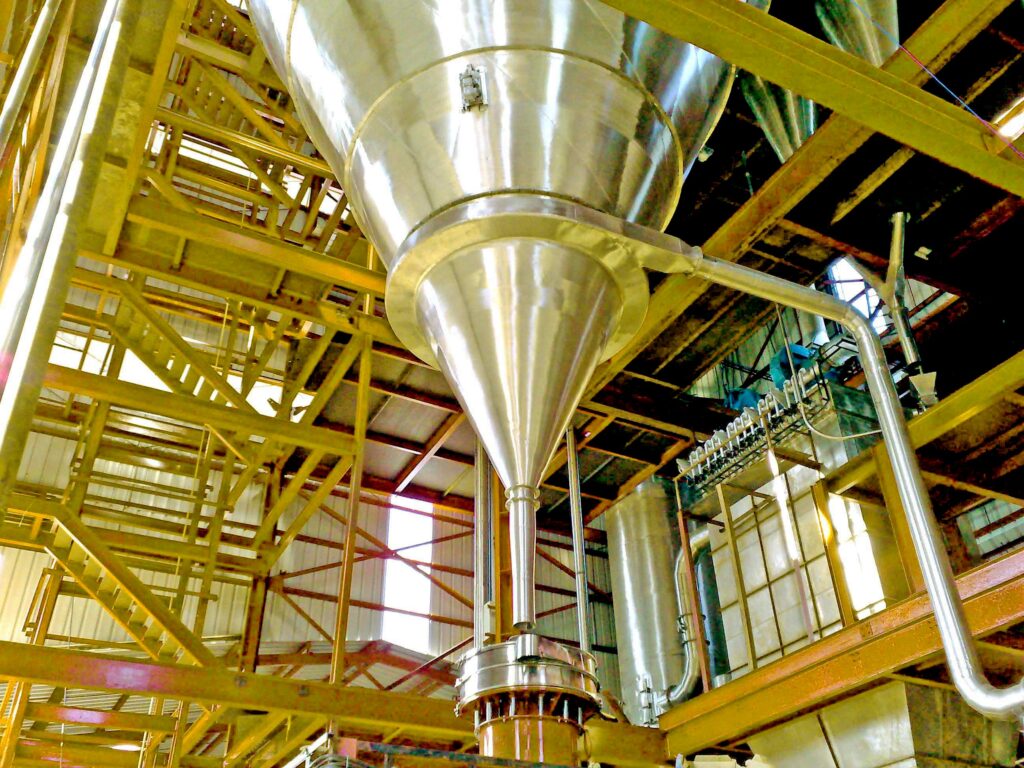
Primary atomization into hot drying air inside the main drying chamber.
Internal fluidized bed continues gentle thermal moisture removal.
External fluidized bed achieves final target moisture and cooling.
Pre-concentration vs. 1,000–2,000 kWh/t in spray towers (45–55% solids).
Process Architecture
DTECH Spray Dryers accept liquid feed and convert it into a dried particulate powder with uniform particle size—even for heat-sensitive materials.
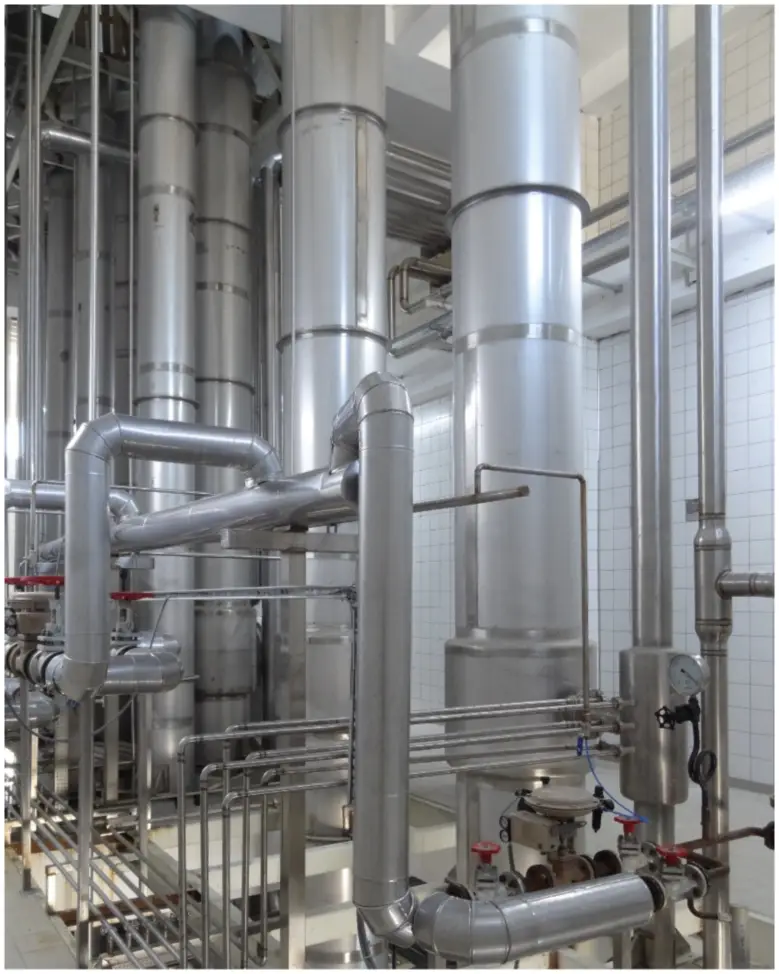
Before spray drying, liquid feed is concentrated in multi-effect falling film evaporators under vacuum to lower the boiling point, protect heat-sensitive proteins, and maximize heat recovery.
Precision calendria sizing is critical: while vacuum boiling reduces scaling, every unnecessary square meter of calendria surface causes ~150 grams of extra fouling per day—directly impacting product loss and CIP stoppages.
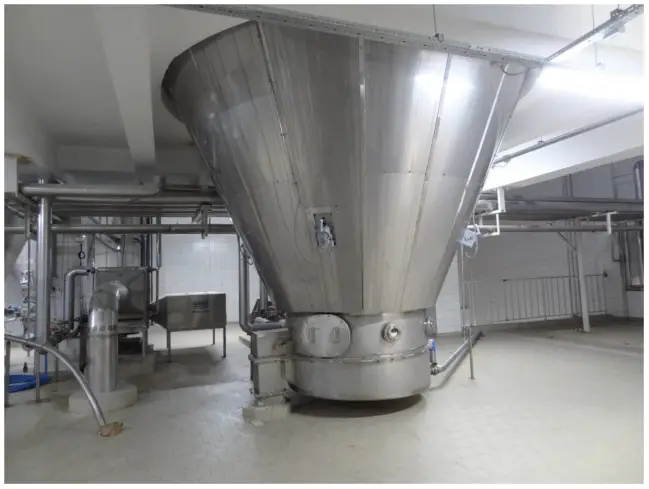
Main Spray Drying Chamber & Tower
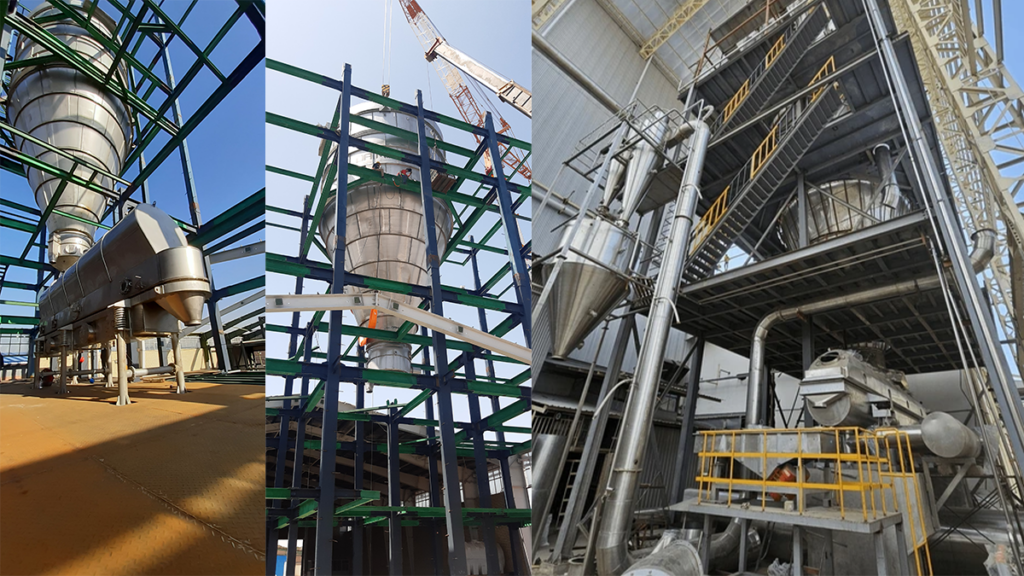
Turnkey Plant Installation & Piping
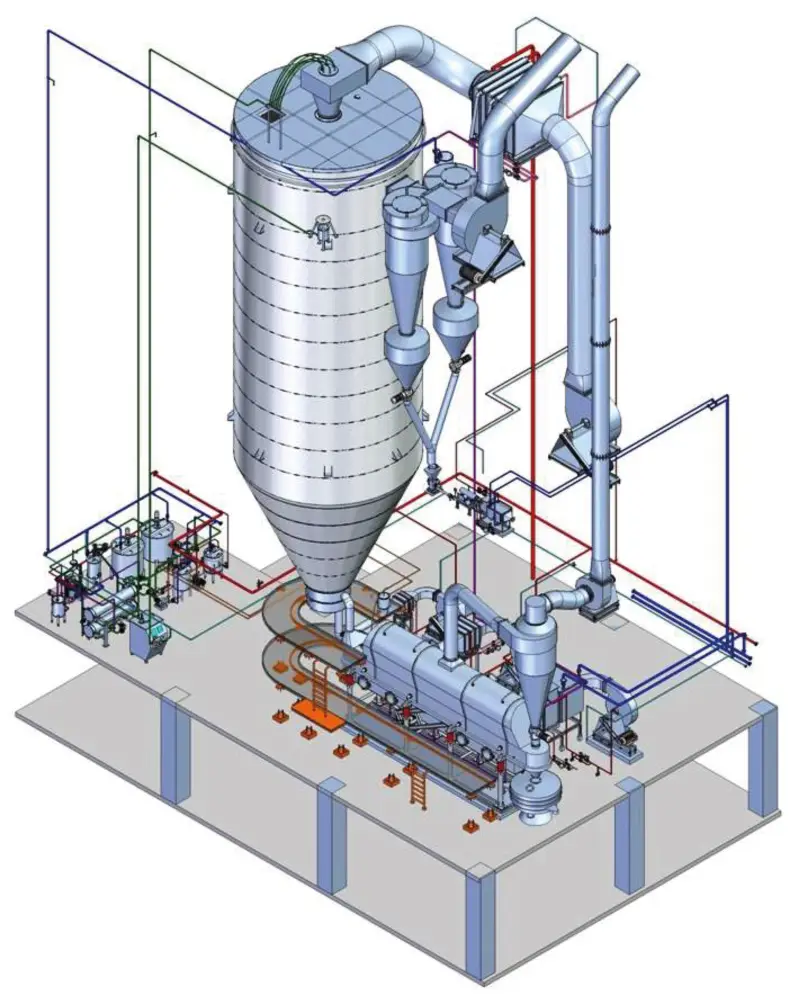
Cyclone & Powder Recovery Module
Fluidized Bed & Air Handling Assembly
Multi-Effect Falling Film Evaporator
Applications
Dairy Powder Engineering
Dehydrating milk extends shelf life dramatically compared to liquid milk—tailored by thermal treatment intensity and membrane concentration.
Classified by Whey Protein Nitrogen Index (WPNI), measuring undenatured whey protein (mg/g). Spray drying achieves superior agglomeration for instant milk powder, while drum drying suits chocolate caramelization.
Produced from standardized milk pasteurized at 80–85°C to inactivate lipolytic enzymes that would otherwise degrade milk fat during storage.
Whey Protein Concentrate (WPC) is concentrated from sweet or sour cheese whey, while Milk Protein Concentrate (MPC) is derived from skim milk using membrane filtration prior to drying.
Technical Guide · Working Principle
A spray dryer turns liquids into free-flowing powders or granules in a single step by atomizing feed into a temperature- and velocity-controlled hot air stream.
Components are combined, viscosity is adjusted, and the liquid mixture is homogenized for uniform atomization.
Liquid feed is pumped into a spray nozzle or spinning disk, breaking it into fine, uniform droplets.
Droplets meet the hot air stream in the chamber; air temperature and flow rate regulate particle size, morphology, and residual moisture.
Dried powder is separated via centrifugal force in a cyclone or bag filter for packaging or downstream processing.
Key Drying Rate Factors: Droplet size, inlet/outlet air temperature, air velocity, and product moisture content are regulated to ensure consistent powder quality.
Uses a spinning wheel for high-capacity output and maximum feed flexibility—handling high-viscosity feeds and abrasive slurries (with ceramic wheel inserts).
Uses high-pressure pumps (up to 300 bar) to produce uniform, narrow particle size distribution with high bulk density and flowability—widely used in food and dairy.
Mixes liquid feed with compressed air or steam (4 to 10 bar) inside a small chamber to create fine droplets; commonly selected for pilot dryers.
Combines integrated bottom-cone fluid beds and external vibrated fluid beds (2-stage and 3-stage systems) to produce agglomerated powders and eliminate dust.
Designed for oxidation-sensitive products or flammable organic solvents, using nitrogen as the drying medium with a cooler/condenser for solvent recovery.
Industries & Engineering Economics
Instant coffee, tea, milk powders, egg products, infant formula, and flavors—preserving aroma, flavor, and color while minimizing microbial load.
Powders, granules, tablets, and active ingredient encapsulation with uniform particle size, stability, and preserved potency.
Catalysts, pigments, detergents, and solvent-based chemical solutions requiring consistent particle morphology.
High-throughput production of animal feed, fertilizers, and pesticides with stable bulk handling properties.
Gentle drying of recombinant proteins, vaccines, and biopharmaceuticals while preserving active biological efficacy.
Wastewater, solid waste, and air pollution treatment streams converted into manageable dry solids.
Low-melting skincare fats are atomized as molten liquid into a cold air stream to solidify into free-flowing cosmetic powders.
High-surface-area cathode and anode powders for EV batteries, accelerating high-purity lithium production with lower energy costs.
Our magnetic-bearing rotary atomizer eliminates high-maintenance gear drives, mechanical bearings, shafts, oil lubrication, and cooling systems—and integrates directly with existing spray dryer installations for rapid ROI.
French engineer Alexis Millardet first used spray drying in the 19th century to produce dried wine yeast. Commercial adoption accelerated in the 1920s–1930s with the first industrial spray dryers, evolving from early nozzle atomizers to high-speed rotary atomizers used across global industries today.
Equipment Configurations
Custom-engineered spray drying lines sized to your hourly evaporation rate, feedstock viscosity, and target powder bulk density.
High-throughput single-, 2-stage, and 3-stage towers with integrated & external fluidized beds, fines re-circulation, and CIP/SIP automation.
Request Industrial Sizing ↗Compact units using two-fluid or rotary atomizers for product development, formulation testing, and small-volume specialty powders.
Request Pilot Specs ↗Nitrogen closed-loop drying with solvent condenser recovery for flammable organic solvents, oxidation-sensitive actives, and sterile pharma.
Request Closed-Cycle Specs ↗Lifecycle & Optimization
Get more out of existing drying assets with capacity rebuilds, explosion protection, and waste-heat recovery.
Hazard zoning audits, explosion venting/suppression, and thermal monitoring to protect operators and prevent dust deflagration.
Magnetic-bearing rotary atomizer retrofits, high-efficiency cyclone/bag filter upgrades, and fines return optimization without full replacement.
Multi-effect falling-film pre-concentration and exhaust heat recovery audits to cut thermal energy draw and boiler fuel usage.
Select your application to receive DTECH’s tailored engineering sheet and layout parameters directly on WhatsApp.
Technical FAQ
Rotary (centrifugal) atomizers handle high capacities, higher-viscosity feeds, and abrasive slurries with maximum flexibility. Pressure nozzles (up to 300 bar) produce a narrow, uniform particle size with high bulk density and flowability—commonly preferred in food and dairy plants.
Multi-effect falling-film evaporators remove water at only 100–300 kWh per ton of water compared to 1,000–2,000 kWh/t in a spray drying tower. Concentrating dairy feed to 45–55% solids before atomization dramatically lowers operating cost.
In a 3-stage system, feed dries to ~10% moisture in the main chamber, ~6% in the internal fluidized bed, and ~3% in the external fluidized bed—producing agglomerated instant powders with minimal dust.
Yes. We supply both pilot/R&D units (using two-fluid or rotary atomizers) and full industrial lines, as well as magnetic-bearing rotary atomizer retrofits, cyclone upgrades, and energy/safety audits.
Share your feed material, target moisture, and hourly evaporation capacity directly with DTECH engineers on WhatsApp.
DTECH · Solution provider for food, dairy & process industries